From Smart Tech to SMART Content Goals

For many technology-led companies, the New Year brings a familiar ambition:
“We need to get our content working harder.”
The capability is there. The technology is genuinely impressive. The business is heading in the right direction. Yet content often becomes the weakest link - not because teams don’t care - but because it’s asked to serve too many purposes at once, without enough strategic clarity.
In founder-led, technically complex organisations, content doesn’t just communicate externally. It also has to work internally. That’s where most content plans quietly fall apart.
The content planning problem
Strategic conversations about content often start well, but end vaguely:
“We should be clearer about what we do”
“We need content that positions us better”
“Let’s be more consistent this year”
Reasonable statements, but wishful. Without clearer intent, content activity tends to:
• Drift towards tactics before strategy
• Become shaped by internal preferences not external need
• Struggle to gain sustained buy-in from founders
The result is action without direction.
Why smart tech companies struggle with content
In technically sophisticated businesses, content challenges are rarely surface-level. They usually stem from:
• Multiple founders or senior stakeholders, each with valid but different priorities
• Highly nuanced capability, which resists simplification
• A legitimate fear of misrepresentation, especially when explaining complex systems
• Content becoming political, rather than strategic
In this environment, content decisions feel risky:
- Say too little and you undersell capability
- Say too much and you lose the audience - or your IP!
Without a shared framework, progress slows and confidence erodes.
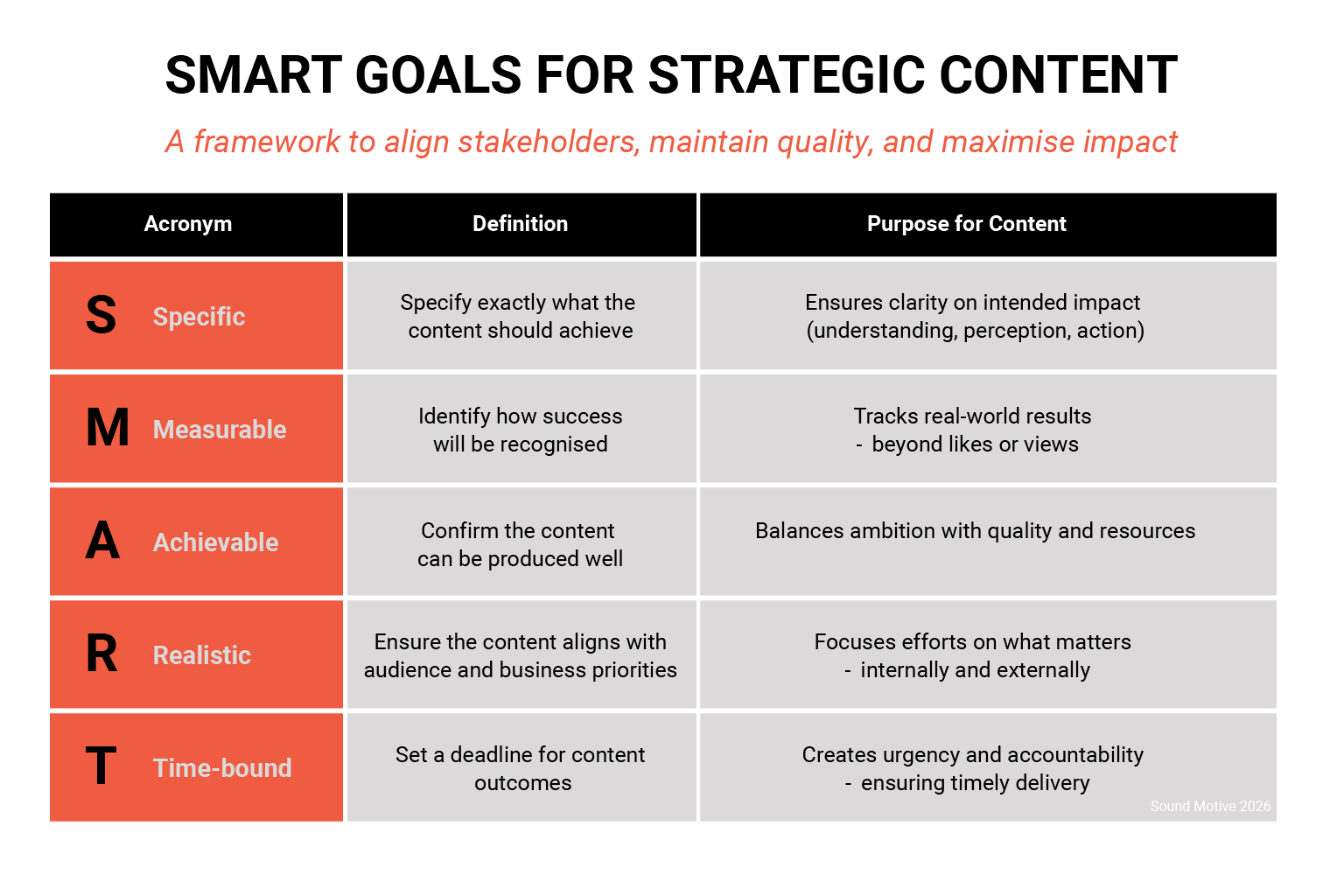
Using SMART goals to de-risk content decisions
The familiar SMART framework can be applied as a strategic alignment tool to guide content decisions. SMART goals help translate...
• C-suite intent
• Commercial objectives
• Technical reality
...into content that everyone can get behind. Reframed for content strategy, they ask:
Specific - What must this content achieve in terms of clear outcomes?
Measurable - How will we recognise success in business terms, not just engagement metrics?
Achievable - What can realistically be produced at a high standard without diluting quality or focus
Relevant - Who is this really aimed at and how does their understanding need to change?
Time-bound - When does this content need to deliver results by?
These questions remove subjectivity and give stakeholders clarity and focus when making creative choices.
Where smart technology meets SMART content goals
When content is treated as a strategic asset rather than a marketing output, priorities shift. Instead of asking “What content should we produce?” the question becomes smarter:
“What do we need people to understand about our capability?”
From there:
• Narrative comes before channels
• Clarity comes before creativity
• Alignment comes before production
For smart tech businesses, this often results in:
• Fewer pieces of low-quality content
• Clearer positioning
• Assets that support sales, partnerships, and stakeholder conversations
Visual content such as animation, motion graphics and live-action video perform better when driven by storytelling that honours commercial interests while still satisfying audience expectations.

Defining and protecting quality as you scale content
One of the biggest unspoken concerns in smart technology companies is quality. Not just production quality, but:
• Accuracy
• Clarity
• Consistent narrative
As content activity increases, the risk isn’t doing too little. It’s losing control. This is where light-touch content governance becomes essential. Effective governance doesn’t mean layers of approval or rigid rules. It means agreeing, upfront:
• What “good” looks like for this business
• What must always be true in how capability is presented
• Who has final responsibility for sign-off, why and when
In practice, this often takes the form of:
• A clearly defined narrative framework
• An appropriate number of quality benchmarks
• An agreed review process that protects the brand without delivery bottlenecks
When governance is clear, content becomes safer to produce and easier to scale.
What effective content strategy looks like in practice
When content planning is genuinely strategic, you typically see:
• Founders aligned on what the company is saying and why
• Content that communicates capability without oversimplifying
• Reduced internal friction around messaging and direction
• Assets that can be confidently reused across the business
Most importantly, content stops feeling like a risk and starts behaving like a tool.
The New Year isn’t about producing more content. It’s about creating shared understanding - internally first, externally second. For smart technology companies, SMART goals often provide the structure needed to make that happen.
Sound Motive has worked with technology-led companies to balance technical nuance with clarity and alignment, helping teams maintain quality while scaling their content production.
Read our Oxford Space Systems Case Study as an example.